
AI Writer Check
Review your draft before you share it
An AI text checker helps you slow down at the right moment: before a draft becomes a submission, campaign or message to a colleague. Check a short passage free, then decide which parts need your attention.
Check the wording and the substance
AI-like writing often feels smooth but says little. Repeated summaries, vague benefits and interchangeable examples can weaken a piece even when a human wrote every word. Use the checker to investigate those patterns, not to label the author. Read the result together with the purpose of the document and what its audience needs.
A detection estimate is not a factual check. A passage can sound natural and still contain a wrong date, invented quotation or misleading comparison. Verify sources independently, especially when your content makes claims about health, finance, employment or a product.
Choose a representative passage
For the free check, paste 40–800 characters of prose. Pick a section with complete sentences rather than a title, list of keywords or bibliography. Short and heavily formatted samples offer limited context, so be cautious about interpreting them. Remove identifying information and confidential details before submission.
The explanation helps you understand the estimate. Full reports in the app add passage-level signals and document workflows. Review passages in the original document so headings, quotations and technical vocabulary are not mistaken for unexplained shifts in writing style.
Turn the review into an editing decision
For content and marketing teams, ask what the reader should learn or do. Replace generic claims with specific, supportable information. Add examples from your actual experience, remove filler and make the next step clear. For HR, make sure descriptions reflect the role and organisation rather than a reusable template.
If you use an AI-assisted rewrite, compare it with the original sentence by sentence. Keep your intended meaning, check names and numbers, and disclose assistance where your school or workplace requires it. You can check the revision again, but a lower score is not proof of authorship. Clear, useful writing is a better goal than optimising for a detector.
A final review before you submit or publish
Start with the brief. Find the main argument, the evidence behind it and the conclusion it supports. If they are difficult to locate, improve the structure before worrying about AI patterns. A clear answer with traceable sources is more useful than polished paragraphs that avoid taking a position. Ask whether every section contributes something the reader needs. Remove repetition even when it sounds natural, and explain necessary technical terms rather than replacing them with vague alternatives.
For editorial and marketing work, check each claim against information your team can support. Replace revolutionary product language with the concrete problem being solved. Remove imagined customer stories. Confirm that quotations were approved and that names, dates and product details are current. Natural wording does not mean verified content. A detector does not validate a source, confirm a testimonial or establish permission to publish. Those checks belong in your normal editorial process alongside the writing review.
For HR, read the document from the candidate’s perspective. Does the role description explain the work, essential requirements and next step? A template can help, but it should not hide differences between positions. When reviewing an application, regular or formal writing is not a reason to reject someone. Ask about relevant experience and use established criteria. If you discuss a detector result, explain its limitations and give the person a genuine opportunity to describe their process.
After editing, compare the revision with the original. Keep notes of meaningful changes when colleagues must approve factual claims. A second check may highlight different patterns, but your decision should remain about clarity, accuracy and audience. Use a short sample to understand the explanation and a full report when surrounding context matters. Keep the original open so you can inspect each highlighted passage where it belongs. Finish by checking the next action is clear and that the document answers its actual question.
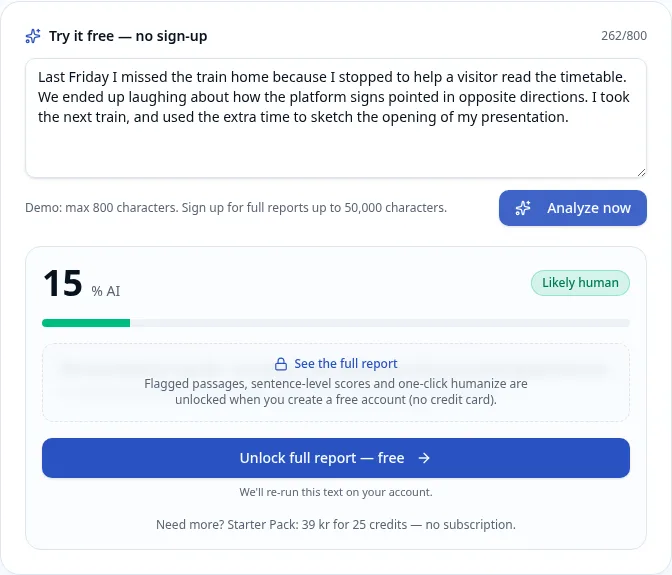
A real short-check result. This example is not an accuracy test.