
AI Writer Check
Review student writing fairly, with context
A detector result can help you choose a question to ask. It should never decide a student's grade or become an automatic accusation. Use the free short check alongside drafts, sources and the student's explanation.
Set expectations before the assignment
Explain which uses of AI are permitted. Distinguish brainstorming, language support, editing and generated answers. Ask students to document assistance in a way that fits the task. Clear expectations make later conversations more useful than trying to infer a policy breach from the final text alone.
Design the process so learning is visible. Notes, an outline, an early draft and a short discussion can show how an argument developed. These are not perfect evidence either, but they provide context that a text-only detector cannot access. Follow your institution's assessment and privacy procedures.
Interpret a signal with care
Regular sentences and formal transitions can be associated with AI writing. They can also reflect a rubric, language learning or careful proofreading. Short excerpts and specialised vocabulary may be particularly hard to interpret. Read the explanation and the full assignment, and avoid treating a score as a probability that a student cheated.
AI Writer Check offers a short login-free estimate and, in the app, reports with flagged passages. Use those passages to identify questions about wording or reasoning. Verify references separately. Do not upload identifying student information without permission and an appropriate basis for processing it.
Have a constructive conversation
Ask the student how they approached the task, why they chose a source and how they reached a conclusion. Give them space to show drafts and explain revisions. Avoid presenting the tool as infallible. If you have concerns, follow the established review process and give the student a fair opportunity to respond.
For teaching revision, demonstrate how generic claims become stronger with a specific example and a clear explanation. If students use a humanizer, require them to review facts and preserve their meaning. Rewriting should support learning, not obscure the origin of work. The best use of a detector is to support thoughtful review while recognising that detection is never certain.
Use a fair, documented classroom process
Start with the learning objective: interpretation, research, argument or reflection. Explain permitted assistance and disclosure. Final prose is only one view of learning. A short reflection, source discussion or draft comparison may show understanding a detector cannot measure. Choose these activities because they support learning, not simply to catch students out. Make expectations available before submission and distinguish language support from generating answers. Apply the same standard consistently and explain how concerns will be reviewed.
Describe concerns in ordinary terms. A reference may not exist, an example may not support the argument or terminology may be unexplained. Ask about that issue directly. Do not open with a percentage as proof of misconduct. Additional-language writers and students following rubrics may use regular sentences. Offer everyone the same opportunity to explain. Consider whether tutoring, proofreading or an unfamiliar topic could account for a style change before drawing conclusions about its origin.
Ask open questions: how did you choose the source, what changed between drafts, and why does the example support the conclusion? Listen before deciding on further review. Record evidence and unresolved uncertainty. Follow institutional procedures, including the student’s right to respond. Do not introduce an unofficial automated penalty or circulate reports unnecessarily. A detector explanation can help choose a question, but the student’s work and process must remain central to a fair assessment.
Use revision practice to teach stronger writing. Compare a generic claim with a specific example tied to a real source. Invite students to explain changes and acknowledge help. Keep identifying details out of demonstrations without an appropriate basis and permission. For assessment, combine conversations with drafts and the assignment. Sometimes evidence remains inconclusive; acknowledging that is fairer than turning uncertainty into misconduct. Review your process with colleagues so its limitations and safeguards are understood before a difficult case occurs.
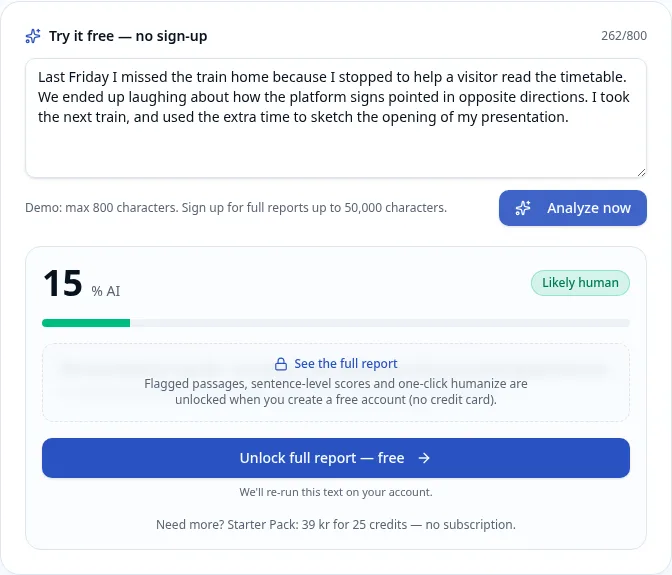
A real short-check result. This example is not an accuracy test.